Myanmar
I. Introduction
In November 2019, we launched an educational aid program in Myanmar. Myanmar is the poorest country in Southeast Asia, with an economy comparable to that of 1970s China—its GDP amounts to approximately $1,300. Some villages have only three hundred households, and just two of them have access to electricity, reflecting deep and widespread poverty.
In 2021, Myanmar was hit by a severe pandemic, compounded by a coup that plunged its people into dire hardship. Lives were threatened at every turn—people risked dying from virus infection or being blown up by bombs, forcing many to flee their homes. Orphanages and schools could not operate; food and basic survival became the most pressing issues. According to the United Nations Humanitarian Needs Overview report, "half of Myanmar's population lives in poverty."
The foundation has entrusted teachers from local schools and orphanages to recommend outstanding students regardless of ethnicity. Middle school students receive a scholarship of $150 per year, high school students $300 per year, and university students are offered interest-free loans.
II. Project Activities:
1). Provide financial aid to students from impoverished families who excel academically and morally;
2). Donate to the orphanage's "One Bowl of Porridge" project;
3). Donate water purifiers for Chinese schools;
4). Donate books.
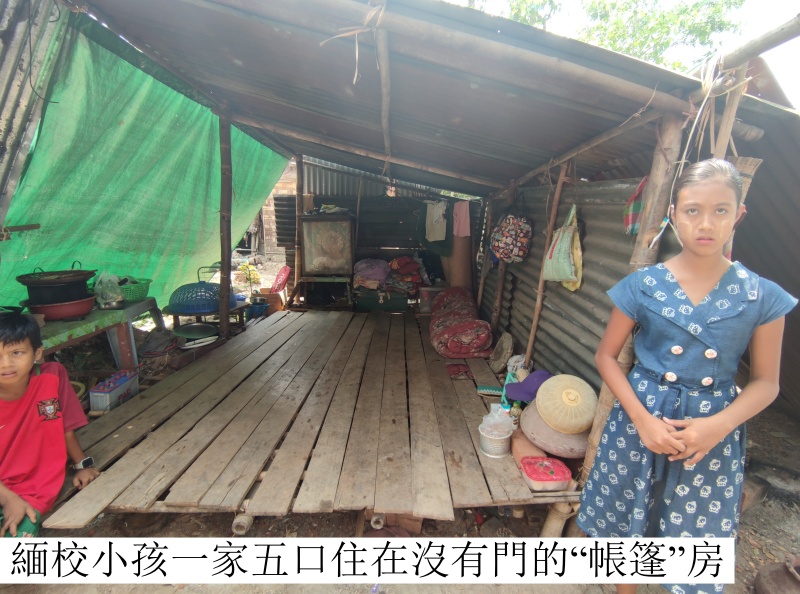
Myanmar school students: There are no dormitories at the schools, so children attend classes on a day-to-day basis. Most villagers live in bamboo-framed houses, wooden boardhouses, or thatched huts. The homes are constructed with a framework of thick bamboo poles, covered with uneven wooden planks laid on the floor, then padded with straw mats as beds. The roofs and walls are made from woven reeds, and holes are patched with plastic sheets. Living in such bare, impoverished conditions is truly unimaginable—nothing but a pot and an old blanket make up their entire household possessions. They don't see any food at home; children say they survive by eating tender leaves from roadside plants or occasionally bringing small amounts of food from family members.

The Peizhi & Ai Myan Foundation has partnered to support 20 students from Myanmar schools in regions including腊戌 (Lachin), Iloving, and Bago.
Chinese schools: Lakhto is the city with the largest Chinese community in Myanmar, just a four-hour drive from Ruili, China. There are 105 Chinese schools in Lakhto, all independently established by local communities. Many of these schools are very basic, constructed solely from bamboo leaves and strips, with only a few old tables and chairs.
The water quality in Lakhto, Myanmar is poor, with high levels of lime content. The raw water has a quality above 600. Peizhi has donated over 20 water purifiers to the Lakhto Chinese School. After purification, the water quality ranges from 9 to 25, offering excellent results comparable to mineral water and safe for direct consumption. Over ten thousand teachers and students have benefited.
Orphanage students: The orphanage environment is harsh, with children sleeping in wooden boardhouses and beds made of just a few planks. In addition to orphans and single-parent families, it also takes in children fleeing from war zones and those from impoverished households. The orphanage relies on donations—what they receive is what they eat. Some directors even lead the children in gardening, but daily meals cost less than $0.72. Despite this, the children are only able to meet basic hunger needs, suffering from severe nutritional deficiencies.
Peizhi, in collaboration with the Yangon Aiman Foundation, is helping children from 40 orphanages in Yangon, Lwunna, and Magway regions complete their secondary school, high school, and university education.